Skip to content
Independent service company Refrigeration only: built-in and integrated columns, freezers, wine storage, undercounter units and ice makers. Mon–Fri 8am–6pm · Sat 9am–4pm · Sun closed
Setpoints 38°F Fresh food 5°F Ice production 0°F Freezer
Series · CL

Sub-Zero Classic series — the CL cabinets

Classic is the current name for the full-depth built-in platform. The CL prefix replaced BI, but the architecture is continuous: a top-mounted condenser and two independent sealed systems.

Current series 2022 onward Reviewed

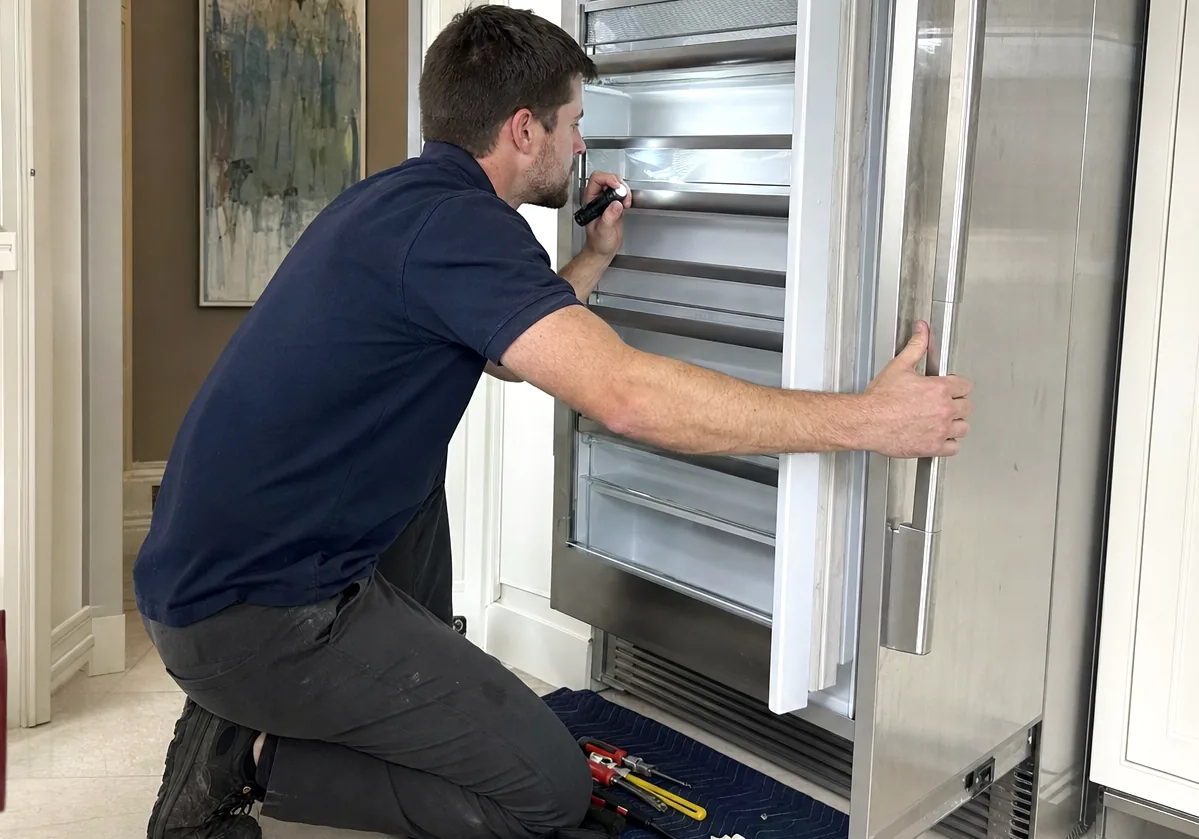
The stainless door of a built-in refrigerator held open at the handle, kitchen cabinetry running away behind it.
The Classic cabinet: stainless outside, two separate machines inside.
Series data
Classic series data
Series nameClassic
Plate prefixCL
Former nameBuilt-In
Production2022 onward
CondenserTop-mounted
Sealed systemsTwo — one per compartment, two compressors, two evaporators
Water filter4204490 or 9030868
Service codesEC50
Representative models
  • CL3650U
  • CL4250SD
  • CL4850SD
Series notes and exceptions
Classic exceptions
Condenser locationTop, behind a flip-up grille
Sealed systemsTwo, one per compartment
Setpoints38°F fresh food, 0°F freezer
Water filterTwist-in 4204490 or 9030868
Former series nameBuilt-In, model prefix BI
Failure profile

What this series actually presents with.

Fresh food warms while the freezer holds 0°F

Fault on the upper sealed system alone, usually the fresh-food evaporator fan or its defrost circuit

SERVICE flashing on the display with EC50 stored

Restricted top-mounted condenser, or a fault the control has logged and is waiting to show a technician

Ice maker fills but produces thin or hollow cubes

Reduced fill volume upstream of the mold, at the inlet valve or a restricted supply, rather than a failed module

Water standing under the crisper drawers

Frozen fresh-food drain, not a blocked one

Door feels locked for several seconds after closing

Normal vacuum seal equalising, not a fault and not a lock

Classic is the name Sub-Zero now uses for the full-depth built-in cabinets that carried the Built-In name and the BI prefix for the previous decade and a half. The plate reads CL. Nearly everything a service company touches in Northeast Florida still reads BI, so both vocabularies matter and both appear on this site.

What a Classic cabinet is

A Classic is a full-depth, flush-inset cabinet with a custom or stainless panel front, built into the cabinetry rather than rolled into a gap. It carries two entirely separate sealed systems. Two compressors, two evaporators, two circuits. The upper system holds the fresh-food compartment at 38°F and deliberately keeps it humid. The lower system holds the freezer at 0°F and keeps it dry.

Once you know that, half the confusing symptoms stop being confusing. A refrigerator that is warm above a freezer that is perfect is not a paradox. It is a fault on one of two systems, and the other one is doing exactly what it was built to do.

The condenser is at the top

On Classic and legacy Built-In cabinets the condenser sits at the top of the unit behind a grille that flips up by hand. That location matters for two reasons. It is easy to reach, so there is no excuse for skipping it. And it is directly above the cooking zone in most kitchens, so it collects a greasy film that ordinary lint does not, particularly in a house that fries.

Clean it every six to twelve months. Every six if there are pets. A cabinet less than six months old does not need it.

Two rules travel with that cleaning. If the fresh-food compartment is already above 48°F against a 38°F setpoint, a cleaning is unlikely to recover it — something has failed rather than fouled. And if the compartment has not returned to setpoint within 24 hours of a cleaning, the unit needs service.

EC50 and the SERVICE indicator

Classic cabinets can display EC50 with a flashing SERVICE indicator. After a condenser cleaning, and only once the compartment temperatures are back near normal, the code is cleared by holding the door-ajar alarm key for fifteen seconds.

If a technician is coming, do not clear it. The stored code is diagnostic data. It tells us when the excursion started and how the control responded, and on a cabinet with two sealed systems that is frequently what identifies which circuit failed. A cleared code costs time on the visit and sometimes costs a second visit.

Water and ice

Classic cabinets take the twist-in filter, part 4204490 or 9030868. That filter improves taste and catches sediment. It is a maintenance item rather than a repair part, and the reason to change it on schedule is flow: a saturated cartridge restricts the supply and produces thin cubes that read exactly like a failing ice maker.

Ice complaints on this series divide into three, and they are different repairs. Thin, hollow or undersized cubes mean water is arriving short, and the candidates sit upstream of the mold — a restricted filter, a supply valve never fully reopened after earlier work, a crimped line behind the cabinet, or an inlet valve not opening fully. A full mold that will not release is a harvest fault: ejector, mold thermostat or mold heater, separated electrically rather than by eye. Water that misses the mold and freezes a slab across the back of the compartment points at the fill tube or its heater.

Before any of that, the compartment is read. Ice production requires the freezer at or below 5°F, with 0°F recommended, and a freezer sitting at 8°F keeps food frozen while quietly refusing to harvest.

The separate air purification cartridge is 7042798. It does nothing for water and replacing it will not change ice quality.

Coverage worth knowing about

The manufacturer’s terms on a cabinet of this generation are two years full parts and labor, five years full on the sealed system, and twelve years limited on the sealed system, parts only.

That twelve-year figure is the useful one. In years six through twelve the covered sealed-system part is still supplied, parts only. A homeowner may have an independent shop do the work: the part is obtained from the manufacturer directly and the homeowner pays the labor. On a compressor or evaporator failure that is the difference between a repair and a replacement, and it is the single strongest honest argument for using a shop like ours.

We do not publish control-board part numbers as definitive, because board fit is serial-dependent. The serial comes off the plate at the visit.

Price bands

What does a Classic series repair cost?

Bands for the work this series is brought in for. Board fit and several sealed-system parts are serial-dependent, so the figure is fixed after the plate is read, not before.

Bands that fit this page, parts and labor
Work Typical range
Diagnostic visit, credited toward the repair $80
Evaporator or condenser fan motor $250–$600
Ice maker, water valve or supply line $230–$630
Compressor or sealed-system repair $900–$2,360
Door gasket or seal replacement $250–$630

Parts and labor together, on this equipment, in this market. The band is where the work lands before it is measured; the figure itself is written down after the diagnostic and before anything is ordered. $80 of it is the diagnostic, credited toward the repair once you approve the work, and $2,360 is the top of the range on this page rather than a price anybody expects to pay. The whole book is here.

Customer feedback

Verdicts on Classic cabinets

4.5 out of 5 across 90 customer reviews. Read all of them.

Water was pooling under the crisper every few days. He pulled the lower back panel, found the drain tube plugged with a frozen slug, cleared it and refitted the drain heater clip that had come adrift.

Devon R.2026-04-22

The upper compartment recovered after a cleaning but drifted again three weeks later. A second visit found a partial restriction in the sealed system. He explained what that meant for the cabinet before we decided anything.

Rosalind E.2025-10-14

A twenty-year-old built-in that everybody else wanted to replace. He read the plate, sourced the correct evaporator fan for that serial run, and the cabinet has held thirty-eight degrees ever since.

Adele F.2026-06-30

Reference

Questions we are asked

Is a CL cabinet different underneath from the BI it replaced?
The plate prefix changed and the architecture did not. Classic is the same full-depth built-in platform with a top-mounted condenser and two independent sealed systems, which is why a diagnosis written for a BI cabinet reads across to a CL one almost line for line.
Where is the condenser on a Classic cabinet?
At the top, behind a flip-up grille, and that is worth knowing before anyone goes looking at the base. Cleaning is a six to twelve month job, halved in a house with shedding pets and unnecessary on a cabinet under six months old.
The display is showing EC50. What should I do with it?
Leave it where it is. EC50 is the control telling a technician that it logged something and when, and clearing it before the visit removes the only record of how the cabinet behaved in the days before you rang.
Independent service company

Classic service

Quote the full model and serial number from the plate. Sub-Zero control boards are serial-dependent, so we never confirm a board number from a description alone. $80 flat diagnostic, credited toward the repair.

Mon–Fri 8am–6pm · Sat 9am–4pm · Sun closed. Scheduled appointments only. No after-hours or emergency service.

40 miles by road from Fruit Cove and St. Johns County. Drive distance, not straight-line radius.

90 days labor, 365 days parts, genuine OEM components.

EPA Section 608 certified technicians — the federal requirement to open a sealed refrigeration system.