Skip to content
Independent service company Refrigeration only: built-in and integrated columns, freezers, wine storage, undercounter units and ice makers. Mon–Fri 8am–6pm · Sat 9am–4pm · Sun closed
Setpoints 5°F Production floor 0°F Recommended
Repair · Ice maker

Sub-Zero ice maker and ice machine repair

Ice production has a 5°F temperature floor, a fill volume and a harvest cycle, and the three of them fail in ways that look identical from the front of the cabinet and are not.

Independent service · Jacksonville, FL $80 flat diagnostic Reviewed

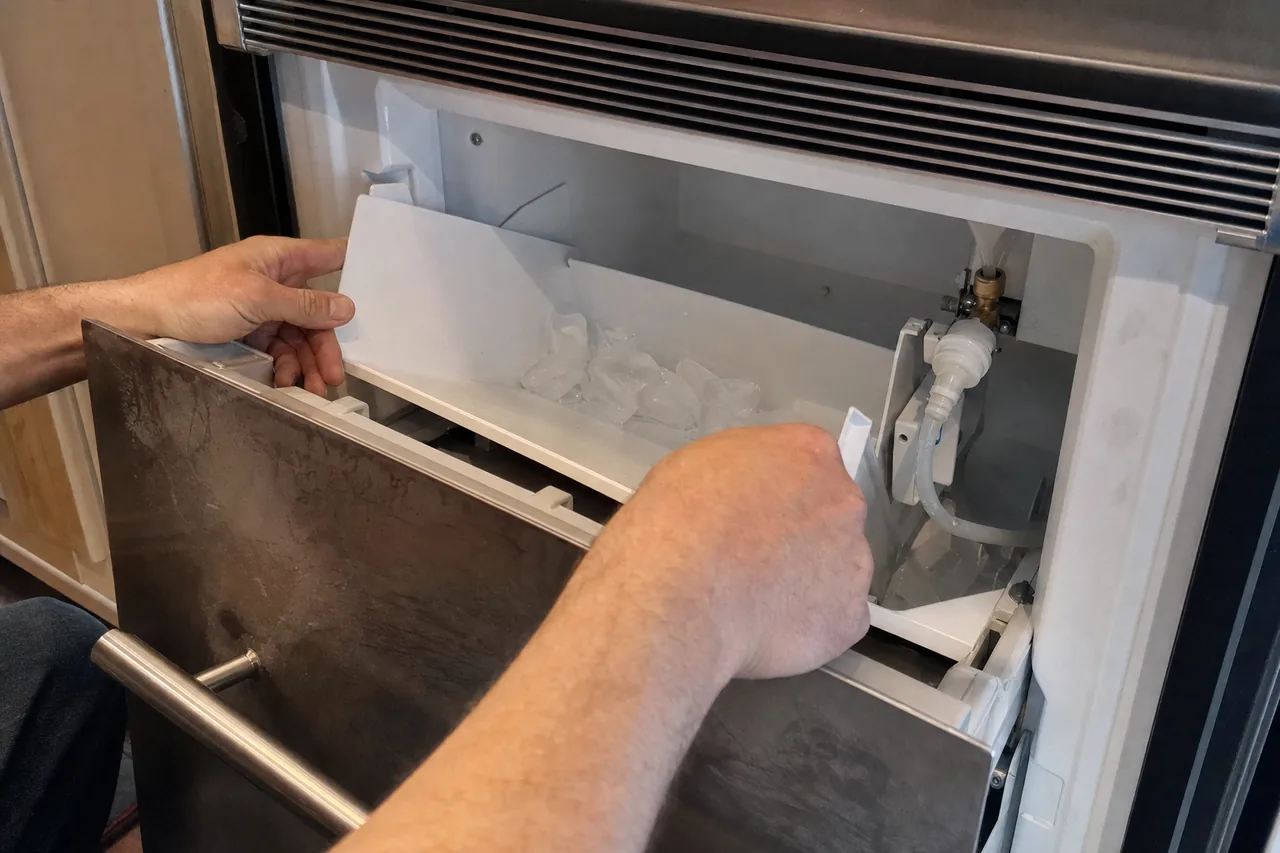
A technician’s hands lifting the ice bin out of a built-in ice maker drawer, a few clear cubes still in it.
The bin comes out first. What is left in it says more than the complaint usually does.
How it presents
  • Ice maker not making ice at all while the freezer still reads close to 0°F
  • Cubes coming out thin, hollow or cloudy
  • Ice maker overfilling and freezing the mold into a solid block
  • A slab of ice frozen across the back of the compartment behind the mold
  • Ice tasting of the filter or of nothing but chlorine
  • Production stopped after the freezer drifted above 5°F
What gets checked, in order
  1. Measure the freezer compartment against the 5°F production threshold
  2. Confirm the water filter part number and age for the series
  3. Measure the fill volume before condemning the inlet valve
  4. Check inlet water pressure and the saddle valve or shutoff feeding the unit
  5. Read the harvest cycle at the ejector and the mold thermostat
  6. Verify the mold heater and thermostat before condemning the module

Almost every ice call arrives described as a failed ice maker. The module itself is one of the least likely causes, and separating the real ones takes about fifteen minutes in a fixed order.

Read the freezer first

An ice maker needs the freezer compartment at or below 5°F to produce. Sub-Zero recommends 0°F. A compartment sitting at 7°F or 8°F will keep food frozen indefinitely and will simply stop harvesting, and the homeowner will book an ice maker repair for what is a refrigeration fault.

So the first measurement on every ice call is the compartment, not the module. If the freezer is above the production floor, the ice maker is behaving correctly and the real question is why the compartment drifted. On a full-size cabinet with two sealed systems, that is a fault on the freezer circuit specifically. On a column it is the only circuit there is. Either way, replacing the ice maker would have fixed nothing.

Then measure the fill

With the compartment at setpoint, the next question is how much water is arriving, and it is a measurement rather than a judgement. A fill that is thirty per cent short still looks like water going in.

Thin, hollow or undersized cubes are the signature of a short fill, and the cause is upstream of the mold. In the order they are worth checking: a saturated filter restricting flow, a supply shutoff or saddle valve never fully reopened after earlier work, a kinked or crimped supply line behind the cabinet, low inlet pressure, and finally the water inlet valve itself failing to open fully.

Only the last of those is a part. The rest are found by looking, and they are the reason we do not order a valve from a phone description.

Then read the harvest

If the fill is correct and the cubes are full size but will not come out, the fault is in the harvest cycle rather than the supply.

A stalled ejector, a mold thermostat that never satisfies and a mold heater that has failed open all present the same way from the front: a full mold that stays full. They are distinguished electrically, not visually, and this is the point at which the panel comes off.

The fill tube is a separate fault with its own unmistakable signature. Water arrives, misses the mold, freezes at the back of the compartment and builds the slab that people report as the ice maker overflowing. The tube has been diverted or its heater has failed. Nothing is wrong with the mold.

Filters, by series

A water filter is a taste and sediment filter and it is a maintenance item rather than a repair part. The reason to change it on schedule is flow: a saturated filter restricts the supply and produces exactly the thin-cube symptom that a failing inlet valve produces, which is why the fill is measured rather than assumed.

The twist-in filters are 4204490 and 9030868, fitted to Classic and legacy Built-In cabinets, Designer and legacy Integrated cabinets, the 648PRO, the PRO3650 and the PRO4850. The push-in filter is 7045454, which replaced 7023812; the older 7005017 and 7023811 are discontinued. The UC-15I undercounter ice maker takes 7042803, which replaced 7012333. The air purification cartridge is a separate item, 7042798, and it does nothing for water.

The machine’s own environment

Undercounter ice makers deserve their own paragraph, because they fail for a reason the built-in ones do not. They breathe through a single low grille that does both intake and discharge, and they run a small mold hard. Block that grille with a cabinetry change, a toe-kick panel or stored boxes and production falls off long before the cabinet itself warms enough for anyone to notice.

Outdoor installations under a lanai are the extreme version. An indoor-rated machine working against ambient air in the nineties runs continuously, drifts through the afternoon and recovers overnight, and no part replacement changes that. We measure air temperature at the grille before quoting, because sometimes the honest answer is placement.

What actually gets replaced

Fill valves, fill tubes and tube heaters, ejector assemblies and mold thermostats account for most of the parts on this repair. The module as a whole is replaced far less often than it is blamed.

Serial numbers matter more here than people expect. Ice maker assemblies changed across the production runs of the same nominal series, so the plate decides which part fits and we read it on site rather than ordering from a model number quoted over the phone. Where a component is on backorder we say so before the visit rather than after the cabinet is open, because a week’s lead time belongs in your decision rather than in a surprise.

Cost and coverage

$80 flat diagnostic, credited toward the repair. Written estimate before any part is ordered. Genuine OEM parts, 90 days on labor, 365 days on parts. If the display is showing a service code, leave it in place for the visit.

Price bands

What does ice maker work cost in Jacksonville?

Bands for the work this page describes. $80 flat diagnostic, credited toward the repair. Written estimate before any part is ordered or any work begins.

Bands that fit this page, parts and labor
Work Typical range
Diagnostic visit, credited toward the repair $80
Ice maker, water valve or supply line $230–$630
Defrost heater, thermostat or sensor $260–$650
Compressor or sealed-system repair $900–$2,360

Parts and labor together, on this equipment, in this market. The band is where the work lands before it is measured; the figure itself is written down after the diagnostic and before anything is ordered. $80 of it is the diagnostic, credited toward the repair once you approve the work, and $2,360 is the top of the range on this page rather than a price anybody expects to pay. The whole book is here.

Customer feedback

Verdicts on ice maker work

4.5 out of 5 across 90 customer reviews. Read all of them.

The ice maker kept overfilling and freezing itself into one solid block. He found the inlet valve not closing fully, replaced it, and then checked the supply pressure so we would know if it recurred.

Stefan A.2026-04-16

The machine had quit entirely after we lost power in a storm. He found the harness connector corroded at the back wall, cleaned and reseated it, and only then started talking about parts.

Rafael T.2026-05-23

Ice was coming out hollow and half formed. He measured the fill volume, found the inlet valve barely opening against our water pressure, and replaced it. The cubes have been full ever since.

Casper M.2026-07-25

Reference

Questions we are asked

Why has the ice stopped when the freezer still feels cold to me?
Feel is not a measurement. Harvesting needs the compartment at or below 5 degrees, and one sitting at 7 or 8 keeps food frozen indefinitely while quietly refusing to make ice. That is a refrigeration fault wearing an ice maker costume, and the compartment is read first for that reason.
Do thin or hollow cubes mean the ice maker has to be replaced?
Rarely. Undersized cubes are the signature of a short fill, and the cause sits upstream of the mold in nearly every case. A saturated filter, a shutoff never fully reopened, a crimped supply line or low inlet pressure all produce it, and none of them is the module.
The ice maker is not making ice. What will the repair cost?
It depends which of the three failures it turns out to be, and the bands for all of them are printed on this page. A short fill traced to a filter or a closed shutoff is the cheap end, a mold thermostat or an ejector is the middle, and a freezer circuit that has drifted above the production floor is the dearest. The $80 diagnostic decides which.
Is the water filter a repair part or maintenance?
Maintenance, and the reason to keep to the schedule is flow rather than taste. A saturated cartridge restricts the supply and produces exactly the thin-cube symptom a failing inlet valve produces, which is why the fill volume is measured before any valve is condemned.
Independent service company

Ice maker repair

$80 flat diagnostic, credited toward the repair. Written estimate before any part is ordered or any work begins. 90 days labor, 365 days parts, genuine OEM components.

Mon–Fri 8am–6pm · Sat 9am–4pm · Sun closed. Scheduled appointments only. No after-hours or emergency service.

40 miles by road from Fruit Cove and St. Johns County. Drive distance, not straight-line radius.

90 days labor, 365 days parts, genuine OEM components.

EPA Section 608 certified technicians — the federal requirement to open a sealed refrigeration system.