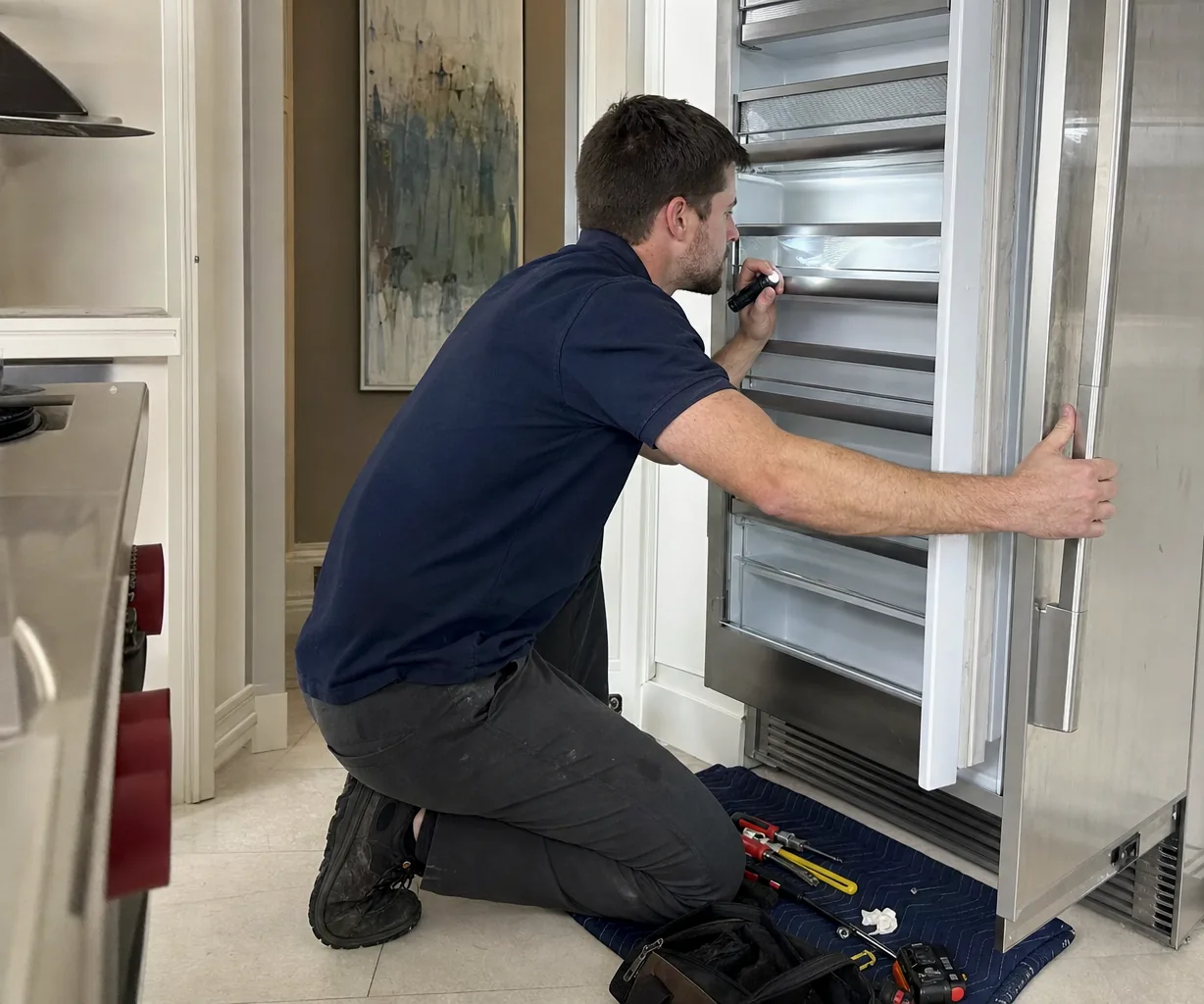
A built-in refrigerator is not a domestic refrigerator in a taller cabinet. It carries two independent sealed systems: two compressors, two evaporators, two condensing circuits sharing one condenser assembly. The fresh-food system is designed to hold 38°F at high humidity. The freezer system is designed to hold 0°F and to stay dry. They are deliberately kept apart so that food does not dry out on one side or absorb odour from the other.
That single design decision changes every diagnosis on this page.
Warm refrigerator, perfect freezer
Customers report this as a contradiction. It is not. It is the ordinary presentation of a fault on the upper sealed system while the lower one continues to work exactly as designed. Any page that describes a warm fresh-food compartment as a problem with the compressor is describing a different appliance.
Once the compartments are read separately, the list of causes is short. A failed fresh-food evaporator fan stops air movement over a coil that is still cold, so the compartment warms while the coil ices. A defrost fault on that circuit lets frost bridge the evaporator until airflow stops entirely. A thermistor reading low tells the control the compartment is already cold enough. A sealed-system restriction or a low charge on that one circuit produces a coil that only partially frosts. Each has a distinct signature at the coil, which is why the evaporator cover comes off before anything is quoted.
The 48°F rule
Sub-Zero publishes a threshold worth repeating exactly. If the fresh-food compartment is above 48°F against a 38°F setpoint, the unit is unlikely to recover from a condenser cleaning alone. Above that line, something has failed rather than fouled.
Below that line, the condenser is the first thing to rule out. A restricted condenser raises head pressure, extends run time, and eventually stops both circuits reaching setpoint. It is also the one cause a homeowner can address without tools. The second half of the rule matters as much: if temperatures have not returned to setpoint within 24 hours of a cleaning, the unit needs service. Waiting a week to see whether it settles only adds a week of food loss.
Condenser location is a series question
On Classic and legacy Built-In cabinets, and on the 430 wine unit, the condenser sits at the top behind a flip-up grille. On Designer and legacy Integrated units, on the 700 Series and on the 427, it sits at the bottom. Cleaning schedule is six to twelve months, shorter in a house with shedding pets, and not required at all on a unit under six months old.
Northeast Florida adds two accelerants. Coastal installations in Ponte Vedra Beach, Atlantic Beach and the St. Augustine waterfront corrode aluminium condenser fins and hinge hardware, and a corroded coil cannot be cleaned back to health. Inland, around sixty-eight thunderstorm days a year put transients on the branch circuit a permanently connected appliance sits on, and the resulting control faults typically appear weeks after the weather rather than during it.
Service codes
If the display is showing a code, leave it. A flashing SERVICE indicator with a stored code tells the technician when the fault began and how the control responded. Clearing it before the visit throws that away, and on several series it also resets the run-time counters that would have identified the failing circuit. The one exception is a code raised by a condenser restriction that has already been corrected, and even then it should only be cleared once both compartments are reading near setpoint.
What the visit looks like
The diagnostic is $80, flat, and it is credited toward the repair. Nothing is ordered and no work starts until a written estimate is in your hands. Parts are genuine OEM; sealed-system and control components are never substituted with aftermarket equivalents. Our own coverage is 90 days on labor and 365 days on parts.
If your cabinet is between six and twelve years old, ask about the manufacturer’s limited sealed-system coverage before you approve anything. In that window the covered sealed-system part is still supplied by the manufacturer, parts only, and an independent shop may perform the work while you pay the labor. It is the single largest saving available on a compressor or evaporator failure, and it is frequently missed.