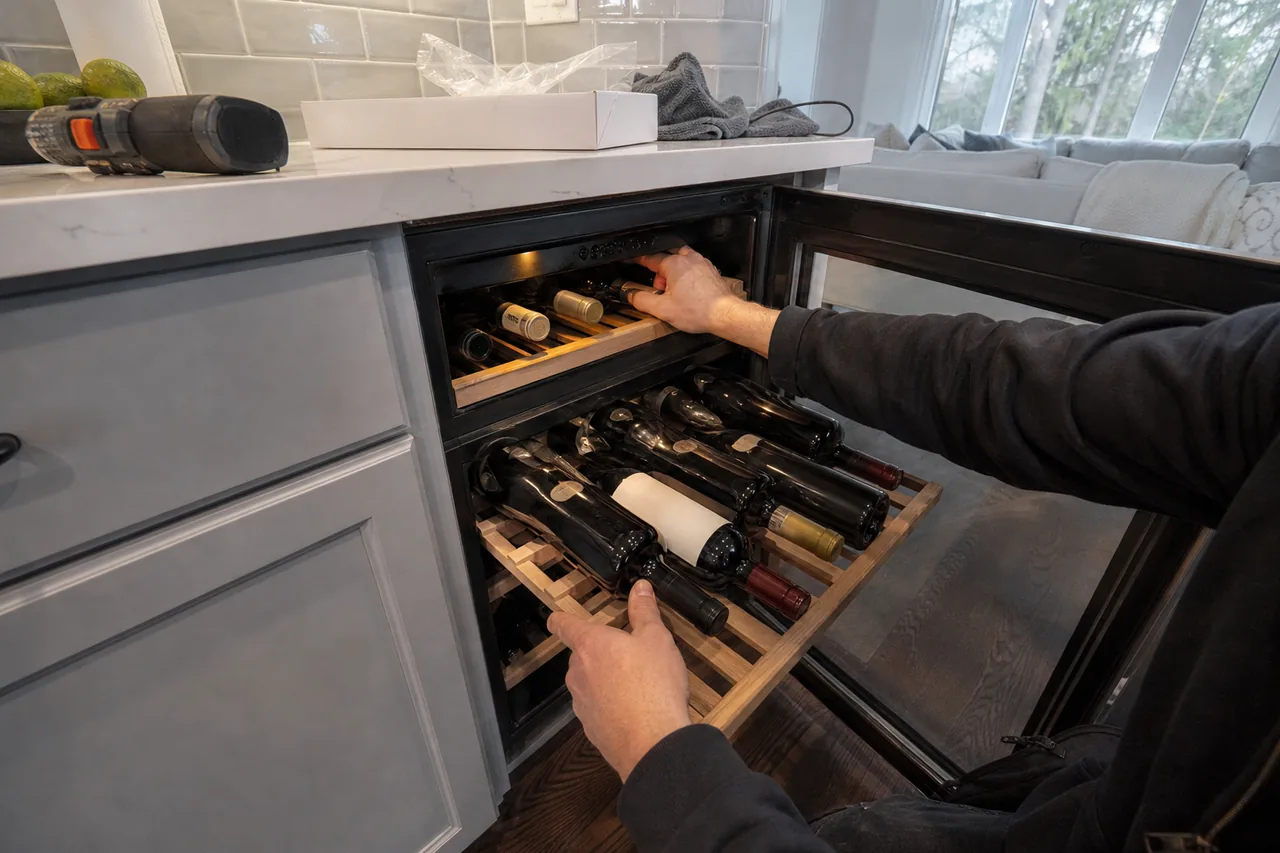
A Sub-Zero wine cooler that is not cooling is most often reacting to something simple: a zone set warmer than you think, a blocked grille, a dusty condenser or a door that no longer seals. Check those four in that order, give the unit a full 24 hours after each fix, and only suspect the fan or the sealed system when the zone stays warm after all of them.
Confirm the zone is really warm
Start with the setting. Designer wine units (IW, DET and DEC), Classic BW and CL units and the UW-24 can each be set anywhere from 39°F to 65°F, while DEU undercounter wine storage runs from 40°F to 65°F. Either zone can hold red or white, so a zone nudged up for reds will feel cool rather than cold, and that is correct.
Then check the display against a thermometer standing in a glass of water on a middle rack overnight. Within a couple of degrees of the setting means the unit is working.
Two situations look like a fault and are not. After any change to a setting, the cabinet needs 24 hours to settle. And a newly installed wine unit may pull down only one zone at a time at first, so on a two-zone cabinet such as the DEU2450W the second zone can trail the first for a while.
Give it room to breathe
A wine unit sheds its heat through a grille, at the toe kick on undercounter models and above or below the door on the taller columns. A rug, a shoe basket or a pet bed in front of it starves the condenser of air. Inside, bottles pushed hard against the back wall or stacked over the air openings stop cold air from circulating, which tends to leave the upper racks warmer than the lower ones. Clear both, and keep the door shut while it recovers.
Clean the condenser the right way
If the condenser has not been cleaned in the last three months and the wine is warm, cleaning it is the manufacturer’s first recommendation. As routine care it asks for a cleaning every six to twelve months, more often with pets in the house, although a unit under 6 months old does not need one yet.
Switch the unit off at the breaker, take off the grille and brush and vacuum the coil along the fins, never across them; bent aluminum fins block air as surely as dust. Then wait 24 hours before judging. Around Jacksonville and the First Coast, the kitchen air a condenser dumps its heat into stays warm and damp for much of the year, so a coil that coped in January can fall behind by July.
Look at the door gasket
Shut a sheet of paper in the door at the hinge side, the handle side, the top and the bottom, then tug each one out: you want to feel resistance. Paper that slips out freely means warm room air is getting past the gasket. Clean it first with the unit off, using mild soapy water and a soft cloth, a baking soda paste for stubborn marks, or one part bleach to ten parts water where mildew has started. Keep vinegar and rubbing alcohol away from it. A gasket that is ripped, cracked or torn has to be replaced. The manufacturer wants a service technician to fit it, and the part comes through its parts distributors rather than from an online shop.
Where the owner checks stop
| What you notice | Likely cause | What you can check | Call a technician when |
|---|---|---|---|
| Zone warm, setting correct | Dusty condenser or blocked grille | Clean the coil, clear the grille | Still warm a day later |
| Top racks warmer than bottom | Blocked air path or weak fan | Move bottles off the back wall | No fan sound behind the panel |
| Frost on the rear wall | Fan or defrost fault | Nothing beyond a look | Right away |
| Compressor runs nonstop, cabinet warm | Sealed system | Nothing | Right away |
Still several degrees warm a day after a clean coil, a clear grille and a sound gasket? Stop there; fans, sensors and the sealed system are not owner repairs. Our wine storage repair visit starts with an $80 diagnostic. As typical ranges, an evaporator or condenser fan motor runs $250–$600, a door gasket $250–$630 and a sealed-system repair $900–$2,360, with the firm figure given after diagnosis. The full list is on what a repair costs here.