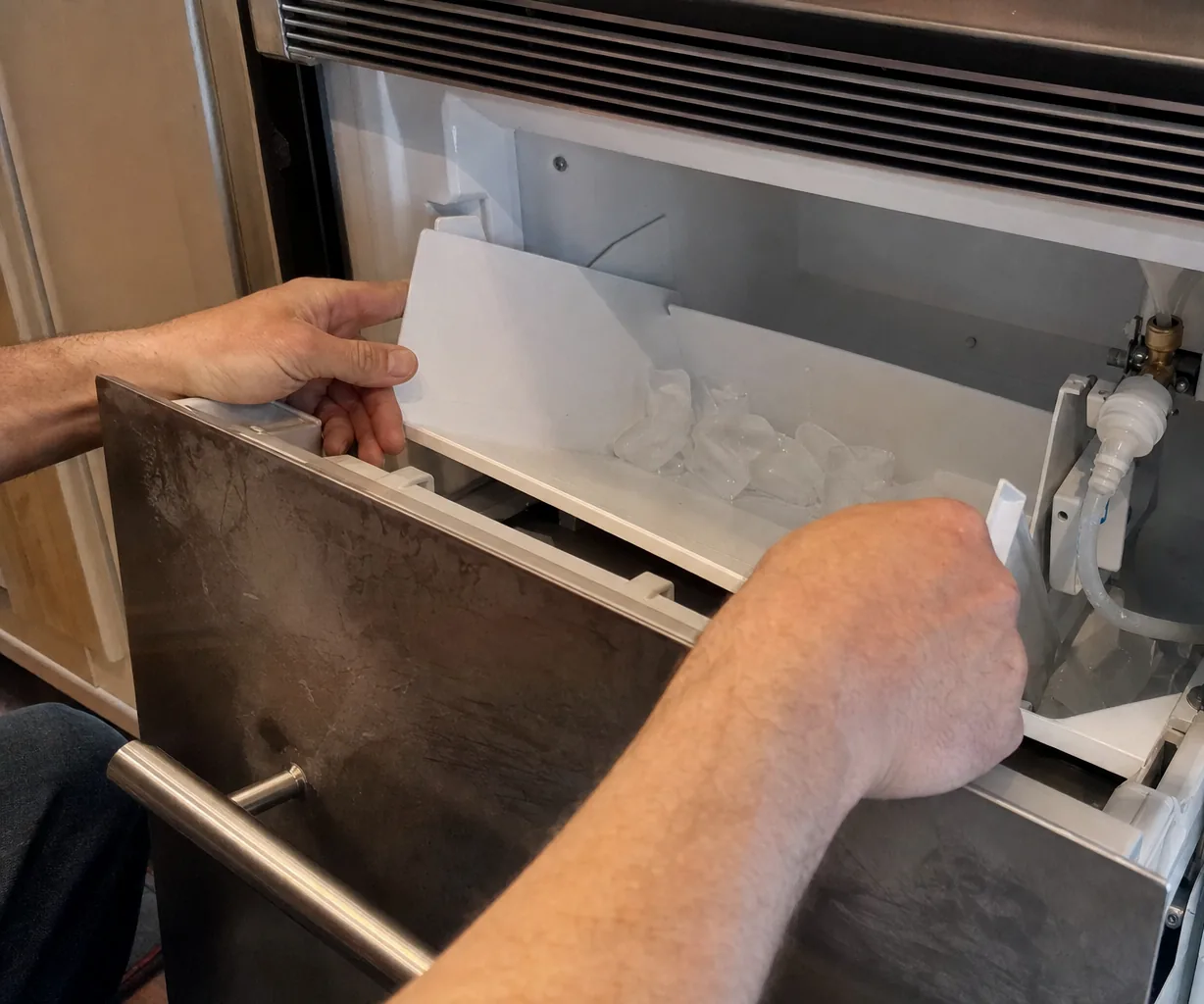
An ice sheet across the floor of a freezer compartment. Water standing under the crisper drawers. Water appearing at the base of the cabinet after a warm spell. Three descriptions of the same fault, and it is a defrost fault rather than a plumbing one.
What the drain is for
Every one of these cabinets defrosts on a cycle. A heater warms the evaporator, the frost that accumulated on it melts, and the meltwater runs off the coil into a pan and out through a drain tube to somewhere it can evaporate.
That path is warm only during the defrost cycle. The rest of the time it sits inside a compartment held at 0°F. If any water remains in the tube when the cycle ends, it freezes. Next cycle, slightly less water gets through. Within a few weeks the tube is solid ice and the meltwater has nowhere to go, so it runs onto the compartment floor and freezes there instead.
That is why the ice sheet builds in layers, and why owners describe it as coming back within days of being chipped out.
Frozen, not clogged
This distinction is the whole point of the page. In the overwhelming majority of cases the obstruction is ice, not debris. The manufacturer’s own guidance says as much.
It matters because the two things people do about a “clogged” drain are both wrong here.
The first is pushing something down the tube. A wire, a skewer, a straightened coat hanger. Behind that tube are a drain heater and an evaporator pan, and both puncture. A punctured drain heater is a parts job. A punctured evaporator pan is a sealed-system job on an appliance that did not have a sealed-system problem when you started.
The second is pouring boiling water down it. It rarely clears the full length of ice — the water cools as it goes and refreezes further down — and it deforms the plastic components in the drain path. Some of the water also ends up somewhere it was not intended to go.
What actually clears it
A controlled defrost. Empty the compartment, disconnect power, and hold the door open with the cabinet allowed to come up to room temperature. Towels on the floor. It takes hours, not minutes, and it is genuinely effective because the ice in the tube is at the same temperature as everything else.
What that does not do is answer the question that matters.
Why did it freeze?
A drain that froze once will freeze again unless the cause is corrected, and the causes are not all the same.
A failed drain heater is the most direct one: the tube never gets warm enough during defrost to clear itself. An open or shorted heater circuit shows on a meter in a few minutes.
A defrost termination fault ends the cycle early, so the coil never fully clears and the water that does melt is not enough to flush the path. A humidity load from a door that is not sealing properly puts more moisture in the compartment than the defrost cycle was designed to handle, which increases the volume of meltwater. On drawer cabinets, a gasket that has taken a compression set on the top edge does exactly that.
There is also a straightforward mechanical version: a drain tube that has been kinked or displaced during installation or a service visit, so it holds water at a low point.
What we do about it
We defrost it properly, we test the drain heater circuit and the defrost termination, we check gasket compression and door alignment, and we look at the tube routing. Then we tell you which of those it was.
That is a longer visit than chipping the ice out, and it is the difference between fixing it and doing it again in March.
Cost
$80 flat diagnostic, credited toward the repair. Written estimate before any part is ordered. Genuine OEM parts, 90 days on labor, 365 days on parts.